Currency
GBP - British Pound

Some of the most impressive gym technology I have tried has been packed into a small cable unit. Some of the least convincing has been attached to a very expensive machine with a very impressive screen.
That probably tells you where I stand. I am interested in what technology can do for training, but the equipment still has to feel good to use. Having tried a wide range of smart kit, and put an early prototype into our own commercial gym, I have found plenty to like. I have also found things that need more work.
Wearable monitoring devices are a big part of the current fitness conversation, but this article is not about wearable tech. This article is about the equipment itself: smart consoles, connected machines, digital resistance and the software that brings them together. Where is it going, what is useful now, and what has yet to earn its place on the gym floor?
EGYM is a useful starting point. Its Smart Strength machines replace the conventional weight stack with electronically controlled motor resistance, combining this with personalised settings, built-in screens and guided training. The machines retain the familiar format of individual strength stations (hell – they even look the same!), but the resistance and workout experience are controlled digitally.
It is worth distinguishing the two jobs. Tracking measures what you do; digital resistance controls what you pull or push against. They can work together, but neither automatically makes the other better.
The idea is appealing. Recognise the member, recall their settings, guide the workout and record their progress. For someone who lacks confidence in a gym, that structure could be a considerable help. I can see its appeal in a corporate health club or a hotel gym, particularly where users want guidance and staff support is limited.
My own experience across the smart machines I have tried has been mixed. Some missed repetitions. Short rests between sets were not always recognised, separate sets could become one long set, and drop sets could confuse the recording. These are observations from my trials, rather than a verdict on every system or the latest version of any particular brand.
Too often, I felt I needed to train according to the software's expectations: prescribed repetitions, a particular rhythm and neatly timed rests. Move away from that and the experience became clunky. I like being able to change my mind during a workout. The machine should cope with that.
More fundamentally, biomechanics must come first. Seat position, movement path, range of motion and the way resistance feels all matter. A screen cannot compensate for an exercise that feels awkward. If a conventional machine gives me better movement and better engagement, that is the machine I will use.
Plus, it’s limited in the sense that you cannot use the tech machines in conjunction with freeweights, unless you record the freeweights via a linked app. In which instance, what’s the point in a tech machine, if you’re recording some of the data yourself anyway? You may as well use the old tried-and-tested machines and record it all on an app.
I still see promise here. The combination needs to become more accommodating of how people actually train. For my own training, much of what I have tried is not there yet.
At home, the proposition changes. Space matters, and a compact machine that offers a wide range of exercises can be much easier to accommodate than a traditional multi-gym and a collection of weights.
Speediance Gym Monster and Tonal are examples of the screen-led approach. Other connected resistance systems include Vitruvian Trainer+, which uses a platform and an app rather than the same large built-in display. They belong to the same broad conversation, although their layouts and ways of working differ.
The resistance on the motor-driven home systems I have tried has been surprisingly good. Electronically controlled motors can produce substantial cable tension from relatively compact hardware. The motor and control system vary between products, but the practical question is how smoothly and accurately they deliver the resistance. Most are incredibly good – much better than you’d anticipate, if you’ve not used any of these machines.
Where I am less excited is the big-screen experience. Part of what you are paying for is an integrated display, guided workouts and the software around them. For some people, that is precisely the attraction. Personally, it reminds me of exercising along to workout videos in the 1980s and early 1990s, brought up to date with interactive resistance and feedback, rather than picking up your Argos dumbbells. For me, it’s a modern-day workout video at home.
There is nothing wrong with that. If someone enjoys it and trains consistently, it is doing something useful. But the resistance technology interests me more than having another screen in the house.
I also think about longevity. A good bench and dumbbells can remain useful for decades. Connected equipment also depends on software support, compatibility and, in some cases, subscriptions. The buying decision includes how well the whole system will age. I think we already know the answer to that, given what’s happened to your workout VHS tapes and DVD’s.
The biggest surprise was how much I liked the smaller devices that concentrate on providing a cable to pull against.
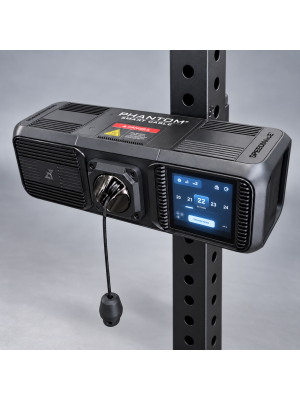
The PHANTOM Smart Cable is our Phantom-branded version of the Speediance Gym Nano. It puts digitally controlled resistance into a portable unit with a small display. The current specification lists up to 100kg of resistance and 5.1 metres of cable travel, with settings for standard resistance, increasing resistance, eccentric loading and fixed-speed work.
That long cable is useful. On a conventional stack machine, pulley ratios affect both the resistance at the handle and the available travel. Here, long travel and small electronic adjustments give you useful flexibility without the need to consider increment jumps and cable ratios at the time of purchase. The motor and transmission still have their own operating limits, of course.
What impressed me most was the feel. There was proper resistance from a remarkably small package, with software that could do something useful to the exercise itself. Change the setting and you can change how the movement path is loaded.
I bought an early prototype for our gym. This is where enthusiasm meets reality: it does not get used very much. People try it, appreciate it, and then return to the equipment they know. It gets left switched on, the battery goes flat, and somebody has to remember to charge it.
That experience matters. A clever device needs to become part of someone's training routine to justify its place. A conventional weight stack is always ready, requires no charging and is familiar to practically everyone on the gym floor. I suppose it’s not wildly different comparing electric cars to the traditional internal combustion engine car.
For home use, I find the compact cable concept much more convincing. One owner can learn it, keep it charged and build their sessions around it. For anyone short of space, there is a lot to like. Our prototype's limited use in a commercial gym does not take away from how well the underlying idea and product works.
[INSERT PHANTOM SMART CABLE VIDEO HERE]
https://www.youtube.com/watch?v=4b0sat0e6n0
That brings me to a different route for commercial gyms: adding smart tracking to existing equipment.
When I first encountered the CYCLOPS connected pulley concept, it did not particularly excite me. My initial impression was that we would be replacing a perfectly serviceable pulley with a more expensive one so an operator could monitor machine usage. Useful information for a large facility, perhaps, but hardly something to get me excited about training.
The later offering of member-facing application changed my view. On an equipped machine, a user can connect through a QR code and use the associated app to see and record workout information. CYCLOPS describes automated repetition, load and peak-force data, alongside progress tracking.
Now I am interested. Think about the machines people already love using: a Hammer Strength pec fly, an old-school Nautilus leg extension, or a JAWS Prime SPLIT-FORCE Vertical Row. Where the particular machine's cable system and pulley arrangement are compatible, this sort of retrofit could add tracking while retaining the movement that made it worth owning.
That qualification matters. A connected pulley is not a universal replacement for every pulley on every machine. Fit, cable routing and the setup required to produce meaningful data need checking. Independent arms and multiple cable paths also need consideration.
For members who want the data, there is an extra tool. For those who simply want to sit down and train, the aim is for the machine to feel and work as it did before. There is no need to make everyone interact with a console.
I like that approach. It offers a way to update suitable equipment without replacing an entire gym floor. The cost still needs assessing machine by machine, including any ongoing software charges, but the modest investment is a very different proposition from buying a complete fleet of smart machines.
We are exploring CYCLOPS as a possible retrofit option for compatible JAWS stack machines, and potentially as a separate retrofit product. I’m still not sold, when people can simply record their data on an app, if this is what they want to do, but for a digital-age experience, this perhaps offers the best overall compromise.
One tangent I explored was whether a spin studio could combine electricity-generating bikes with lighting that reacts to music. Riders visibly powering the atmosphere around them is a lovely idea.
I spoke with Energym about its bikes and LEDSnaps about its lighting. LEDSnaps' PACE system offers music-reactive lighting for studios, with controls intended for fitness instructors. Of these two ideas, I found the lighting the more immediately convincing addition to the class experience.
The energy side needs a closer look at the numbers. In our January 2026 correspondence, Energym said its bikes could generate around 180Wh per bike per hour, depending on the riders and class format. It generally recommended self-generating bikes without a central energy storage system for studios of fewer than 15 bikes, because of the storage system's cost. That is an economic recommendation, rather than a minimum number of bikes that can work. To be clear, existing spin bikes power their own monitors, the idea of the Energym bikes is that they contribute toward your self-sufficiency as a business/ building electricity-wise.
To work alongside the LED-Snaps model just didn’t work to cover all the electricity required – running demand, maybe, but the start-up demand of the system is too great. Therefore, you’d need to rely on the grid. Also, the variable output would likely warrant a battery to make this worthwhile. Then, is a battery coupled with solar the better option? Almost certainly, yes. A nice contributory thought to energy efficiencies nonetheless.
Back to the music reactive lights, in isolation. For our own independent gym, I could not make the overall investment stack up, at all. There is a substantial hardware commitment, and the experience has to generate enough additional business to justify it. A premium studio may reach a different conclusion, especially if its lighting and technology are central to what members are paying for. It is cool, after all.
I like the idea. I can admire the effect. But there are much cheaper ways to add atmosphere to a spin class, particularly where the class already works hard to cover its costs. For us, it remains an “I'd like it, but I'm not paying that” purchase.
Where I think gym technology is heading
I expect compact digital resistance to find a strong place in home training. In commercial gyms, optional tracking that can be added to good existing machines makes sense to me, too. Both offer something useful without requiring us to rethink everything we enjoy about training.
I am much less convinced that large smart machines, built to resemble conventional strength equipment, represent the future of the gym floor. I see them occupying a particular niche, much as pneumatic resistance machines from Keiser and other manufacturers have done. Alternative resistance systems, including springs, have their applications. Their existence does not make the weight stack obsolete. It has to make commercial sense (be cheaper or more appealing) or be bloody brilliant (better than what comes before it) to make general market sense.
Meanwhile, free weights and old-school plate-loaded machines remain central to the training experience. To my eye, there is a renewed appetite for equipment that harks back to the bodybuilding gyms of the 1980s. With more people discovering strength training, that traditional approach has plenty of life in it.
There is a parallel with books. The arrival of eBooks prompted predictions about the demise of print, yet physical books remain very much with us. Convenience matters, but so does the experience of using something.
Training is particularly physical and visceral. Loading plates, moving a stack and feeling the resistance through a well-designed machine are part of the enjoyment. An experienced lifter may value that far more than a screen telling them what they have just done.
Having tried this equipment, I have found specific technologies that genuinely interest me. The small cable units surprised me, and the retrofit pulley made me reconsider something I initially found boring. I can see a practical place for both.
My expectation is a gym floor where useful technology sits alongside equipment we already love. Interactive screens on a treadmill or stairclimber make perfect sense. On gym equipment, give me tracking if I want it, compact resistance where space demands it, and the freedom to train without interacting with software. Above all, give me a machine that feels good to use.
Blog post by Matt (Gym Professor), 4th November 2026