Currency
GBP - British Pound


There are some pieces of gym equipment that never really disappear - they just wait for the industry to catch back up.
The hyperextension is one of them.
For decades, it was a staple. From the hardcore gyms of the 1950s through to the bodybuilding and athletic training spaces of the 1980s, the hyperextension bench was a regular fixture on gym floors. It was simple, effective, and understood by anyone serious about building a stronger posterior chain.
Then, like a lot of genuinely useful kit, it got pushed aside.
During the 1990s and early 2000s, commercial gym design shifted heavily toward selectorised back machines, seen as more “user-friendly” and "can't hurt yourself". The hyperextension - despite its effectiveness - began to disappear from many facilities.
By the mid-00's, the rise of barbell-based strength training in Crossfit meant movements like deadlifts went from the powerlifting and bodybuilding floor to the mainstream. The lift absolutely deserves it's place, but they also nudged more isolated posterior chain work further into the background. Hyperextensions became an even more unfashionable middle-ground.
Then strength and conditioning changed the conversation again.
The late 2000s and 2010s brought a renewed obsession with posterior chain development. GHDs, reverse hypers, glute-focused accessory work, and performance-based training methods all surged in popularity. Coaches and lifters began looking for ways to train spinal erectors, glutes, hamstrings and hip extension more and more.
And that brings us to where we are now.
The modern hyperextension isn’t just back. It’s back bigger, stronger, and far more versatile than before.
Today’s best designs aren’t simply bodyweight benches for pumping out endless reps. They’re built to be loaded, progressed, and programmed properly - turning what was once seen as an “accessory” into a serious training tool again.
That’s why the latest generation can best be described as:
Because once you can add real resistance, everything changes.
Instead of just using hyperextensions as a warm-up or rehab movement, they become a genuine strength-builder for:
And crucially, they allow gyms to give members something they increasingly want:
Targeted, hard-hitting posterior chain work without always needing to load a barbell from the floor.
That matters more than ever.
Not every member wants to deadlift. Not every member can deadlift well. And not every posterior chain session should revolve around axial loading and heavy hinge patterns.
A properly designed hyperextension machine fills that gap beautifully.
At The Gym Revolution, two machines perfectly capture this modern evolution:
This is not your old-school hyper bench - it was the first in a modern-day revival of hyperextension beasts.
The Legacy Hyperextension Extreme is a full-fat take on the movement - being the innovator, we threw everything we wanted in a hyperextension at it. It's maybe a little too much! LOL. It sits firmly in the premium category and is built as a flagship posterior chain station rather than a tucked-away accessory.

This is the kind of machine that instantly changes how members view hyperextensions. It takes the movement from “something in the corner” to a genuine destination piece on the gym floor.
It looks more aggressive. Feels more substantial. And most importantly, it encourages members to train the movement harder and more progressively.
In short: it makes hyperextensions feel super-important again.
Then there’s the more direct, brutally usable option, which we made to be far more accessible (cost-effective and smaller).
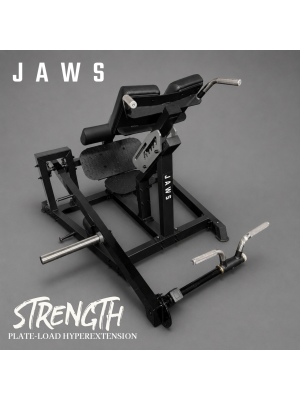
The 45-Degree Plate-Loaded Hyperextension strips the concept down to what matters most: a proven movement pattern, a familiar angle, and the ability to add meaningful resistance. At £1,595, it brings the “hyperextension on steroids” idea into a more accessible, hard-working format for commercial gyms, PT studios, and strength spaces alike. It's more your gym's classic physique, rather than the Mr Olympia above.
This is where the modern hyperextension really wins.
Because the second you can plate-load the movement, it stops being a token bodyweight station and starts becoming a legitimate progression tool.
That means members can move from:
And that’s exactly why this category is becoming relevant again.
The resurgence isn’t random. It’s happening because gym users have changed.
Today’s lifters are more educated than ever. They understand the value of:
They also want machines that feel athletic, look serious, and deliver a burn where it counts.
A loaded hyperextension does all three.
It can be used by:
That’s a very broad appeal for one movement (we'll say two/ three, depending on where you position the pad and add in weighted side-bends).
And in a commercial setting, that matters.
Because the best pieces of kit aren’t just niche. They’re the ones that can satisfy multiple user groups while still feeling distinctive enough to stand out on the gym floor.
The hyperextension has now evolved into exactly that kind of machine.
The old-school hyperextension had one obvious limitation:
once bodyweight got too easy, progression became awkward.
Sure, you could hug a plate. Hold a dumbbell. Get creative with a barbell or sandbag. But it always felt like a workaround rather than a proper solution.
The new generation fixes that.
By building resistance into the machine itself - especially through plate-loaded designs - hyperextensions become:
That’s the shift.
This is no longer just a “back extension bench”.
It’s now a serious posterior chain machine.
And once gym owners recognise that, it starts making a lot more sense why these machines are reappearing in better facilities.
The most successful gyms in the 2020s (forgetting the Covid write-offs of the first 2-3 years) are not just filling space with generic equipment.
They’re curating training experiences.
That means choosing kit that:
A machine like a loaded hyperextension does exactly that.
It speaks to old-school training roots while fitting perfectly into modern gym programming.
That’s a rare combination.
And honestly, that’s why this category is having a moment again.
Not because it’s trendy.
Because it’s useful.
Because it works.
And because, with the right design, the hyperextension has gone from being a forgotten classic to one of the smartest posterior chain stations you can put into a gym.
The hyperextension never deserved to vanish in the first place. We always had one!
But maybe it needed this evolution.
Because now, with machines like the JAWS Legacy Hyperextension Extreme and the JAWS Strength 45-Degree Plate-Loaded Hyperextension, the movement has finally caught up with the demands of modern training.
And the result is simple:
an old-school staple, rebuilt for a new generation. Legacy products!
Hyperextensions on steroids.
Article by Matt Bembridge, AKA Gym Professor