Currency
GBP - British Pound


If you've been looking at power racks over the last few years, you've probably noticed that jammer arms have become something of an obsession.
Not so long ago, there was one or two options. Today, most manufacturers offer several different versions, each claiming to improve on the last. Converging arms, independent movement, rotating handles, adjustable start positions, floating handles, multiple grip options, trolley-mounted systems... the list goes on. In some cases, manufacturers now offer half a dozen different jammer arm systems within the same range.
It begs the question: why?
As someone involved in designing commercial gym equipment, I have a genuine appreciation for the engineering behind these products. I know the amount of thought, design work, prototyping and testing that goes into producing them, and some of the solutions are genuinely impressive. This isn't intended as a criticism of the engineers or the manufacturers. Innovation is what keeps our industry moving forward.
What I do question is whether, in the pursuit of building the ultimate pair of jammer arms, we've started to lose sight of what people actually want from their equipment.
The rise of the home gym has undoubtedly driven much of this.
People understandably wanted more from a single piece of equipment. Garage gyms and spare rooms have limited space, so the appeal of turning one power rack into an entire strength training setup is obvious. Manufacturers responded by developing increasingly versatile attachments, each offering more functions than the last.
From a commercial perspective, it's easy to understand. If one manufacturer introduces a new feature, others soon follow. Before long, the competition isn't simply about producing a good pair of jammer arms, but producing the most capable, most adjustable and most feature-rich version available.
There's nothing inherently wrong with that. In fact, competition often drives some of the best innovation.
The question is whether every new feature genuinely improves the training experience.
Before going any further, it's important to recognise that not all innovation falls into the same category.
Some of the biggest advances in strength equipment over the last decade have come from integrated training systems. Modern racks that combine a power rack, multi-adjustable cable system, lat pulldown, low row and even a Smith machine have transformed what's possible within a relatively small footprint.
The engineering behind these systems is exceptional, but more importantly, it serves a clear purpose. They allow home gym owners to enjoy commercial-grade functionality without filling an entire garage, while many commercial gyms now use them because they allow more members to train within the same floor space.
That's engineering solving a genuine problem.
The best examples don't try to reinvent strength training. They simply make proven training methods available in a more practical and space-efficient way.
This is where my thoughts begin to differ when it comes to some modern jammer arms.
It's engineering for engineering's sake, not for people who actually want to get on and train.
Every additional pivot, rotating handle, locking mechanism and adjustment point can usually be justified individually. None of these are bad ideas in themselves. Many are exceptionally well engineered.
The problem is that, collectively, they often create a product that becomes more complicated without necessarily becoming more enjoyable or more effective to use.
The engineering is designed to make the product more capable and offer more functionality. Whether it actually makes someone train better is another matter.
At some point, practicality gets lost along the way.
One of the reasons the humble power rack has stood the test of time is because it simply works.
Load a barbell, adjust the safety bars and train.
Likewise, dumbbells remain popular because they're quick, intuitive and effective. Cable machines have evolved enormously over the years, but the basic principle remains largely unchanged because it works.
The best pieces of gym equipment often become almost invisible. You don't think about the engineering because it quietly does its job while you concentrate on your workout.
That, to me, is good product design.
If a piece of equipment requires constant adjustment before every exercise, or encourages you to spend more time configuring it than actually using it, I begin to question whether the complexity is really serving the user.
Most people walk into a gym for one reason: to train.
There seems to be an assumption that each new generation of jammer arms must automatically be better because it offers more features.
I'm not convinced that's always true.
Some developments undoubtedly improve usability. Easier height adjustment, quicker attachment systems and better build quality all contribute to a better user experience.
Other developments feel more like an exercise in seeing how much functionality can be incorporated into a single attachment.
The result is often a product that's technically more sophisticated, but not necessarily one that's used any more frequently once the novelty wears off.
The irony is that the more complex jammer arms become, the more they begin to influence the design of the power rack itself. Heavier trolley systems, additional guide rails and increasingly elaborate mounting arrangements can end up compromising one of the greatest pieces of strength equipment ever created.
The accessory begins to dictate the design of the rack, rather than complementing it.
Yes - it's a worthwhile addition and a nice accessory to have. It's nice to have a lever arm to try and mimic some of the lever stations that you'd see in a commercial gym.
Used for what they are, jammer arms can provide useful exercise variety and can be an enjoyable addition to a home gym. They have their place, and I have no doubt they'll continue to evolve.
My concern isn't with jammer arms themselves.
It's with the growing belief that every new version has to be more complicated than the last in order to justify its existence. Sometimes progress genuinely improves training. Sometimes it simply adds another feature to the sales brochure. Knowing the difference is what good product design is all about.
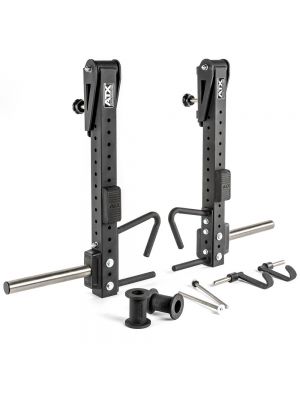
I actually think the more basic lighterweight plug-in jammer arms work better overall for most home trainers longer-term. You can pop them on and off relatively easily and they don't intefere with the rack, when not in use.
The strength industry has never been better at solving real problems. Integrated racks, functional trainers and modern cable systems are all examples of engineering delivering meaningful improvements that have changed the way many people train.
I simply wonder whether jammer arms have reached the point where the pursuit of additional features has started to outweigh the practical benefits they deliver - we're all guilty of driving this - consumer demaning more, manufacturer creating what the customer demands, retailer offering what the customer wants (or, thinks they want).
I appreciate the engineering. I admire the ingenuity. I understand why we've reached the endless wealth of available jammer arms. But, how many are just sat on garage floors, pinned permanantly to the top of racks, or sat in warehouses unsold?
I just think we should never lose sight of why people buy gym equipment in the first place. People aren't there to admire the endless features, although many home gym owners do. They're there to train.
Matt AKA Gym Professor