Currency
GBP - British Pound

If your goal is muscle growth, you've likely heard strong opinions on both sides:
"Free weights are superior."
"Cables provide better tension."
"Machines are safer and just as effective."
The truth? Each type of equipment has a biomechanical advantage when used correctly. For practical gym training, it helps to view these options as complementary pieces of gym equipment rather than rivals.
In this guide, we break down how cable machines, free weights, plate-loaded lever machines and cam-based stack machines compare for hypertrophy - and how to use them intelligently.
Muscle growth is driven primarily by:
The equipment itself is not magic. What matters is how it loads the muscle through its range of motion.

Free weights - barbells and dumbbells - require the lifter to stabilise the load. They are often referred to as freeweights in some equipment catalogues, even our own and the image above.
Movements like barbell squats, bench presses, deadlifts and rows allow heavy loading and long-term strength progression.
However, free weights rely on gravity alone. This means resistance is highest where leverage is weakest and lowest where leverage is strongest. That doesn't always perfectly match the muscle's strength curve - the points at which you are weakest and strongest.

Cable machines allow resistance from almost any angle.
Unlike free weights, cables maintain tension even at the top of a movement (e.g., cable flye vs dumbbell fly).
For hypertrophy, this constant tension can improve metabolic stress and control.
Well-designed commercial cable systems - such as dual adjustable functional trainers - allow extremely precise targeting of muscle groups.
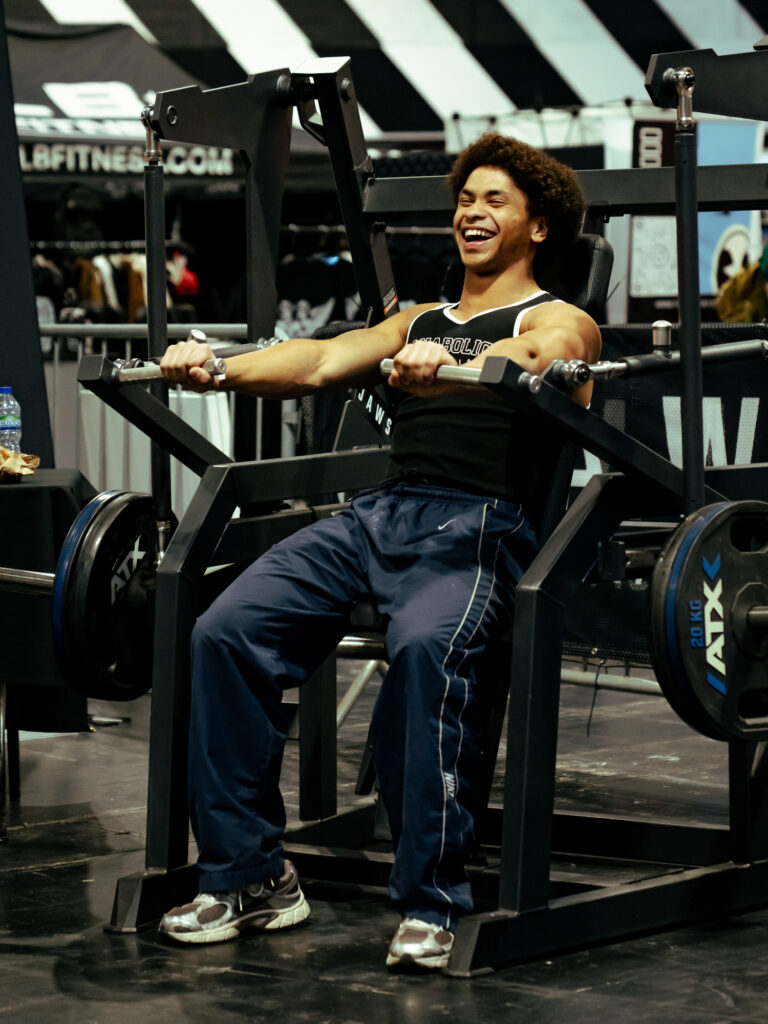
Plate-loaded machines (lever-based machines) combine free-weight loading with guided movement paths.
Because the movement is guided, more focus can be placed on the target muscle rather than balance.
These are especially valuable in hypertrophy phases where pushing sets close to failure is important.
They're often preferred in serious strength facilities because they allow heavy loading without the fatigue cost of full stabilisation.
Stack-weight and plate-load machines with cams are designed to alter resistance throughout the movement.

A correctly designed cam changes the resistance profile to better match the muscle's natural strength curve.
This means:
For isolation movements, like leg extensions or pullovers, this can create a very consistent muscular stimulus.
In busy commercial environments, stack machines are also efficient, quick to adjust and durable for constant use.
The honest answer:
Not better - different.
Each tool offers unique advantages for hypertrophy.
| Equipment Type | Best For |
|---|---|
| Free Weights | Compound mass building and long-term progression |
| Cable Machines | Constant tension and angle-specific targeting |
| Plate-Loaded Machines | Safe heavy intensity work |
| Cam-Based Stack Machines | Isolation and strength curve matching |
The most effective hypertrophy programs combine all four.
A smart approach might look like:
This allows:
Cable machines are not superior to free weights.
Free weights are not superior to machines.
The most effective hypertrophy environments - whether home, commercial or performance-focused - integrate:
When programmed intelligently, each plays a role in building size, strength and durability.
This article is by Matt Bembridge, AKA Gym Professor.
