Currency
GBP - British Pound

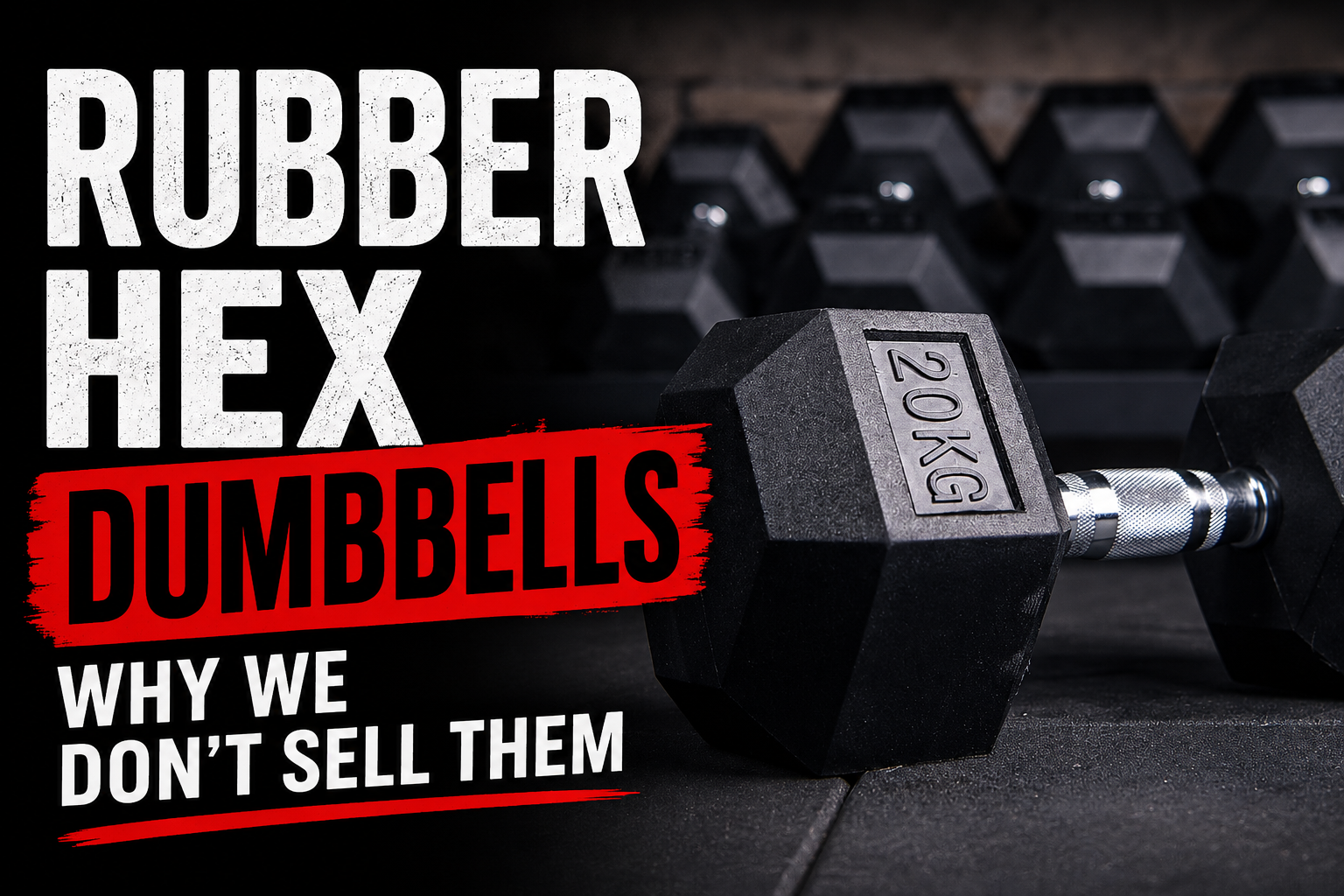
Walk into almost any commercial gym, boutique studio or home gym and you'll find the same familiar sight: rubber hex dumbbells. They have become the industry's default free weight, largely because they're practical, affordable and less likely to damage floors than traditional cast iron dumbbells.
But here's the question very few people ask:
Are they actually well designed?
They're massively popular within CrossFit-style training, where the non-rolling shape and thick rubber surround suit high-volume circuits, floor work and repeated drops. For that application, they make a lot of sense. Personally, though, I've far from convinced they're the best dumbbell for general strength training.
In fact, there are two reasons we've never chosen to stock or sell conventional rubber hex dumbbells. The first is one of industrial design. The second is one of material quality and compliance.
Most people assume a rubber hex dumbbell looks the way it does because that's simply what a hex dumbbell should look like.
It isn't.
The shape found on pretty much all of today's rubber hex dumbbells is actually inherited from a manufacturing compromise dating back decades.
During the 1970s, US manufacturer Ivanko developed what many regard as the benchmark Hex Dumbbell. Rather than simply creating six flat sides, the company invested in tooling that incorporated proper chamfers and fillets to produce a genuine hexagonal form. Similar manufacturing principles had already been used by some earlier UK manufacturers much earlier.
The result was a dumbbell that looked balanced, symmetrical and purposeful. It wasn't merely an aesthetic improvement - it was an example of thoughtful industrial design. The proportions were correct.
The transitions between faces were refined.
The overall appearance reflected engineering rather than cost-cutting.
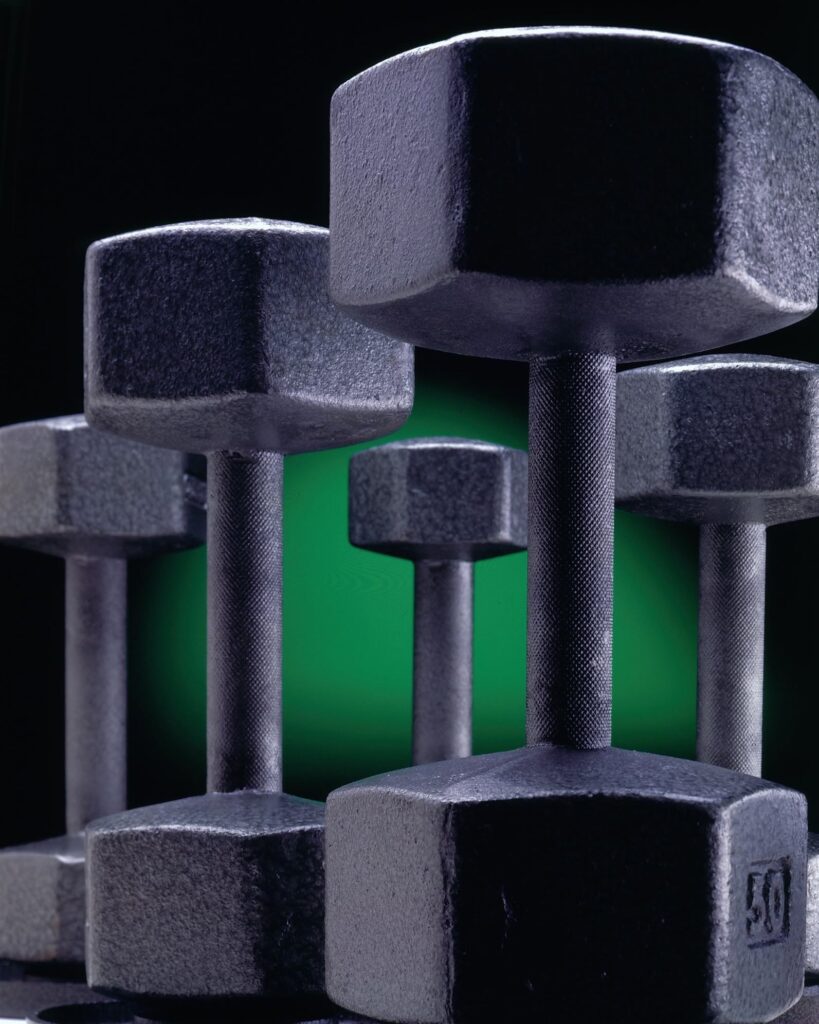
As the wider industry chased lower manufacturing costs, China manufacturers adopted a cruder approach.
Instead of producing a true hexagonal profile, the heads were effectively cast round before machining six flats into them, producing a lopped-off look. The proportions became squarer. The transitions became harsher. The rounded edges disappeared. The design lost much of its refinement.
At the time, this compromise made commercial sense. It simplified manufacture. It reduced production costs. Unfortunately, it also looked cheaper.
When rubber hex dumbbells arrived, the industry had an opportunity to start again.
Unlike traditional cast iron, rubber heads are produced within moulds. Modern moulds can produce almost any external profile imaginable. Rounded shoulders. Refined chamfers. Softer transitions. Better-balanced proportions.
In other words, the manufacturing limitation had disappeared. Yet almost every manufacturer simply copied the appearance of the cheapest cast hex dumbbells. The harsh straight edges remained.
The "lopped-off" look survived - even though there was no manufacturing advantage in doing so.
This happens surprisingly often in industrial design. A manufacturing compromise becomes familiar, familiarity becomes expectation, and eventually nobody remembers why the feature existed in the first place.
Rubber hex dumbbells are perhaps one of the clearest examples within the fitness industry. Almost everyone now assumes a hex dumbbell should have harsh edges because that's all they've ever seen.
It's a little similar with our JAWS Legacy Seatless Adjustable Benches - these are a reimagined offering from something similar in the first half of the twentieth century, before we all got used to training benches looking all the same and the design was forgotten, until we revived it.
Because modern rubber heads are moulded rather than machined, creating a more elegant shape requires very little additional manufacturing complexity.
A better-designed rubber dumbbell could feature:
That's perhaps the greatest irony. Today, a genuinely better-looking hex dumbbell would cost little more to manufacture than the products already filling the market.
Instead, most factories continue reproducing a silhouette that originated from a cost-saving compromise decades ago.
I'd argue that a rubber hex dumbbell without such harsh edges would perform much better, even in a Crossfit environment - they'd still sit the same but would be naturally harder wearing, due to the improved edges distributing impact better and be less prone to chipping.
Of course, appearance isn't everything. Most gym users simply accept rubber hex dumbbells as normal because that's what they've always used.
However, construction quality varies enormously between manufacturers.
Areas that often differ include:
On the surface, many rubber hex dumbbells appear almost identical.
Internally, they can be very different products.
As Recharge Fitness has highlighted in its own article on the subject, "not all hex dumbbells are created equal". Even products that appear visually similar may differ significantly in the quality of materials, manufacturing processes and long-term durability.
One of the biggest concerns, for me, isn't visible at all. It's the rubber itself.
Not every rubber compound is manufactured to the same standard. This bothers me with general free weights and gym flooring alike - products designed to be used indoors and, in the case of home gyms, often within relatively confined spaces.
Higher-quality manufacturers invest in cleaner rubber compounds, tighter production controls and, in many cases, documented compliance with UK and European chemical regulations.
Others provide very little information regarding the composition of their rubber.
That should encourage buyers to ask questions. Especially those purchasing equipment for home gyms.
The UK and EU REACH Regulations exist to restrict or eliminate substances known to present unacceptable risks to human health or the environment.
These regulations apply to chemicals used throughout manufacturing, including rubber products. Unfortunately, documentation surrounding REACH compliance varies considerably between suppliers.
While many reputable manufacturers provide clear evidence of compliance, others provide little or no supporting information regarding the materials used within their products. That's a question every buyer should be asking.
And while this article is about rubber hex dumbbells, don't stop there.
Think about your flooring too. Stable mats may be inexpensive, but they're designed for well-ventilated agricultural buildings - not enclosed home gyms where people may spend hours training.
Many people associate a strong rubber smell with a brand-new gym.
In reality, that smell often comes from volatile organic compounds (VOCs) being released from the rubber compound.
A noticeable odour doesn't automatically indicate a dangerous product. However, it does indicate that volatile compounds are being emitted.
In a large commercial gym with high ceilings and constant ventilation, this is generally less of a concern. In a small garage gym, spare bedroom or garden studio, it's a very different environment. Air volume is lower. Ventilation is often limited.
Buying the cheapest rubber products without understanding the materials they're made from may save money initially, but it's worth asking whether those savings are worth the uncertainty - particularly in enclosed training environments.
People occasionally ask why The Gym Revolution doesn't offer rubber hex dumbbells when almost everyone else does.
The answer is simple. Nobody currently manufactures the rubber hex dumbbell we'd genuinely want to put our name to. Could we commission one? Yes.
Would it cost considerably more than the market is probably prepared to pay? Almost certainly. That's the commercial reality. Probably the best I've seen are by Escape Fitness, although they've tried being a bit too fancy, as they're not quite Hex either. I think a trick may've been missed there.
Most factories continue copying a design that originated as a manufacturing shortcut decades ago. Many offer little information regarding the quality of the rubber compounds being used. Too few are transparent about material standards and compliance documentation.
Could we source rubber hex dumbbells tomorrow? Absolutely. Would we be comfortable putting our name to the vast majority currently available? No.
We'd rather not have the sale.
There are some excellent rubber hex dumbbells on the market, particularly from manufacturers using higher-quality rubber compounds and documented REACH-compliant materials. They're also undoubtedly the right choice for many CrossFit and functional training environments.
Personally, though, I still can't get past the shape. What most people now regard as a "normal" hex dumbbell is actually the legacy of a decades-old manufacturing shortcut. Modern moulding technology removed the need for that compromise years ago, yet the industry continues to copy it without question.
The above is a fairly silly reason - I know. I'm sure one day we'll stock them regardless - I just won't look at them 😂. At the very minimum though, they'll be made to comply with REACH standards - not doing so is a compromise too far.
Outside of CrossFit-style training, I'd choose a quality set of urethane dumbbells every day of the week. In my opinion, they're better looking, better balanced and better to use, longer lasting and represent a product that's evolved rather than simply inherited yesterday's compromises.
Article by Matt Bembridge, AKA Gym Professor