Currency
GBP - British Pound

People ask..
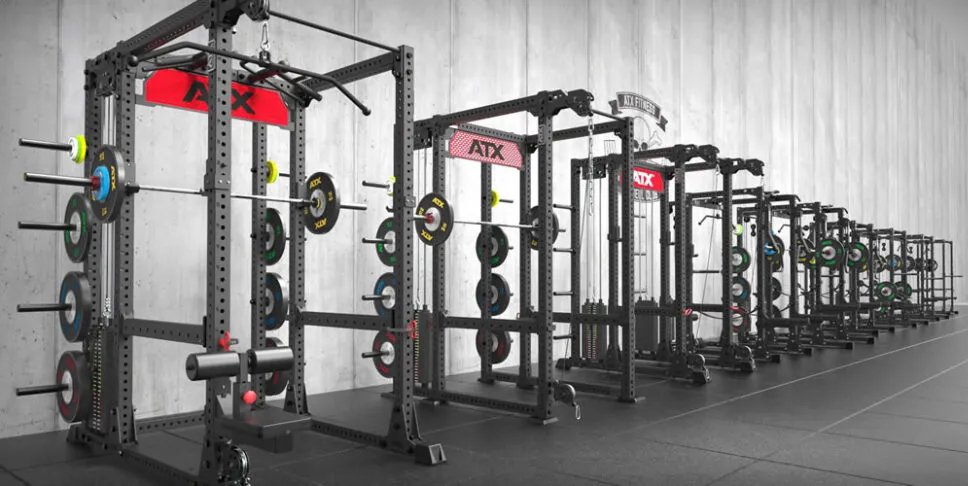
To provide a safer working environment with a free bar (barbell), due to being enclosed by uprights with safety bar cross-sections. Due to being surrounded by steel, it is sometimes referred to as a power “cage”, however, I term a power cage to be a power rack with an extension added to the rear to store weight plates.
Sure, it is okay to bench in a power rack. The adjustable J-hooks and safeties should allow you to achieve a comfortable and relatively safe base to bench press from. A competitive powerlifting may prefer the lower slung height of a competition bench (40cm, compared to 45-50cm of most freestanding benches) and the benefit of a competition bench press having face-savers (triangle plates) built into the safeties. This said, some brands do offer lower-slung freestanding benches and face-saver safeties, including The Gym Revolution.
While many will not warrant an over-engineered build, I do recommend spending reasonable money on a decent build from a reputable brand, which features good finishing touches and certain functional design elements. The below old (8+ years) review of mine of the Body Solid Pro Power Rack highlights some of the functional design issues that I reference. The brand, Body Solid, is good and the build-quality good for home, but the build of this rack is let down by the design.
Key things I recommend looking for are:
If you’re using the rack every day, or one day fail a lift, you’ll thank me for the above.
Should I get a power rack or a half rack?
It’s down to whatever your preference is and how much space you have. Some prefer a half rack, over a power rack, as they feel less enclosed. Those coming from perhaps an Olympic lifting or CrossFit environment will prefer a half rack, as it’s more what they’re used to for certain power lift elements. Some prefer a half rack due to lack of space. Some prefer shoulder press or deadlift in front of a rack and, again, feel less enclosed with a half rack option. A power rack should be safer, if used correctly, and safety booms for a half rack frontage is an available option for most, allowing the best of both, if space permits. If a half rack has short safety booms, then, these are much less good (less safe) for the trainer that requires them.
Yes, remove the safety catches and you can deadlift straight off the floor, within your power rack. Many will choose to, instead, perform rack pulls for ease of loading and lift more weight from a higher start-position; however, as covered in our BAR USAGE GUIDELINES article, a dropped rack pull is the single most damaging thing to a barbell. Many simply do not like performing an orthodox deadlift within a rack but are perfectly happy performing it in front of the rack. If you have space in front of the rack, then, perform it in front of the rack, if this is what you prefer. Can you perform a deadlift within a power rack though? Yes, in most orthodox design power racks.
Safer than what? It has the potential to be safer than a half rack or squat stands, if the safety bars are set to the right height, and you’re using a well-designed and executed power rack. A power rack can certainly help you reduce the risk involved with many barbell exercises, particularly when working to near-failure.
A stable footing is of greatest importance. A concrete floor is a better idea than spongy flooring or a greasy stable mat. If you have the money to spend on flooring, purchase purpose-made gym flooring (I’d opt 20mm rubber and glue composite slabs). For looks and a functional purpose, putting an 18mm block of plywood between the tiles, for the working area of the rack, will create a recessed platform of a stable base underfoot and will look the part, too.
Maybe not; However, if you are performing a wide-variety of barbell lifts at home, or in a gym, a power rack is a solid choice to perform these exercises for improved set-up, comfort and safety.
No, very few power racks are designed with the intention of bolting down. The few bolt-down versions that we’ve released through ATX is more to fulfil demand, as they’re perfectly sound left freestanding. The overwhelming majority of power racks we sell are intended to be used freestanding. In the circumstance of very heavy and constant use, you may find that even the most industrial of power racks shifts over time, with constant heavy weight being put back into it. In this circumstance, the bolt down option can be used as a locator to simply avoid against that “shift”. We’ve done this with one of our industrial power racks, which is favoured by many strong men. It is not actually bolted down, as we’ve used it many times for comps, but there are bolt holes in the floor, which we use as locator plugs to avoid the rack shift. This is an extreme situation though and not typical in many home or commercial facilities.
I don’t even want to answer this question. Factoring that asking this question likely means the rack is painted only (not galvanised) and you’re in an environment prone to steel oxidisation (cold and wet), I do not consider leaving a piece of steel outside to degrade that you, then, wish to lift heavy weights from is a good idea. A rusted-out J-hook or safety will only fail once.
Far enough away that the path of a loaded barbell travel is not interrupted by the proximity of the power rack to the wall. The actual rack distance from the wall may vary depending on the rack design, although the upright distance will remain approximately the same.
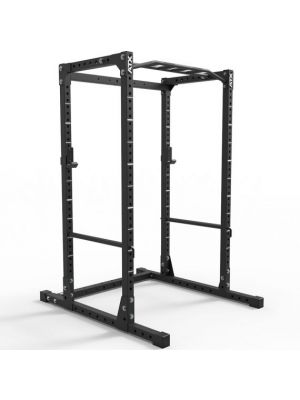
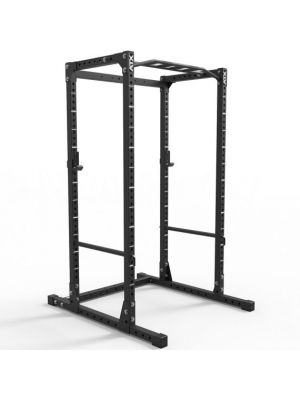
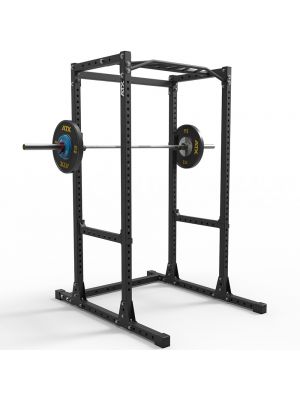
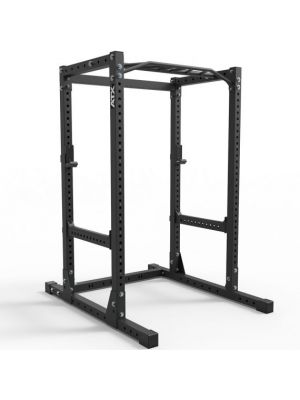
I’d personally start at our ATX 600-series of racks if you are tight on budget, starting from £599. If budget is less of an issue, the sensible man’s choice is the PRX-750 that we offer, which is just under £1000 GBP. I’d spend more on a cage extension, too, for ease of loading and storage, whether this be a home or commercial gym. Many other attachments and accessories are, also, available for you to customise your gym/ power rack to your liking.
Yes, I consider squats is one of the primary reasons for selecting a power rack. Over the past 15 years, power racks have generally replaced squat racks in commercial gyms and have become the number one choice for most home and garage gyms.
There’s less of a walk out on a power rack, compared to a squat rack, and the rear uprights do stop your travelling back to far. Both are good choices for squats, but the versatility of a power rack, other than just squats, is likely why it’s favoured more and more, these days.
Side note: Many older squat racks had a fixed safety. As power racks have adjustable safeties, people leaving the safeties out of a power rack altogether certainly does not make them safer. A safety will only work if it’s located and at the right height for the user.
Your power rack height selection is usually determined by your ceiling height and your height. At 5ft 9”, I’m fine with all but overhead lifts in our shortest 198cm power racks, such as the PRX-610 or PRX-710; however, I would not choose these options, if I had greater ceiling height. I do not feel enclosed with a power rack, as some do and thus favour a half rack, but I’d choose a taller rack, if my ceiling height allowed for it. Many racks will be made circa 230cm to fit in a modern-day European house build with 240cm high ceilings. In a commercial gym, it’s sometimes nice to have even taller racks, for the feel of space, albeit users will then often use a step up to use a power rack pull-up bar.
I hope you have found the FAQ helpful.
Thanks for reading 👍
Matt
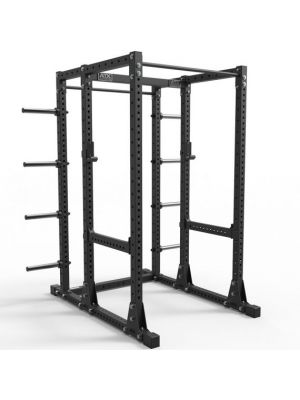
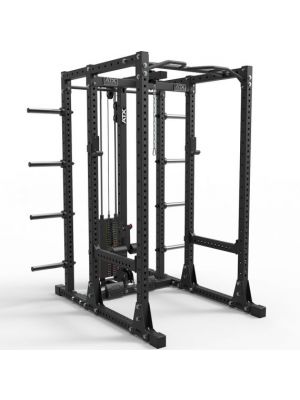
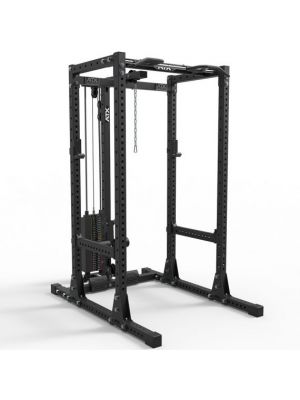
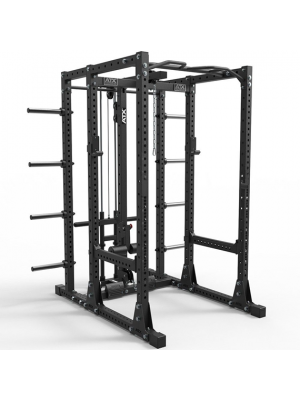
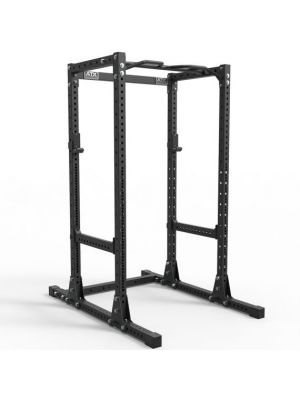
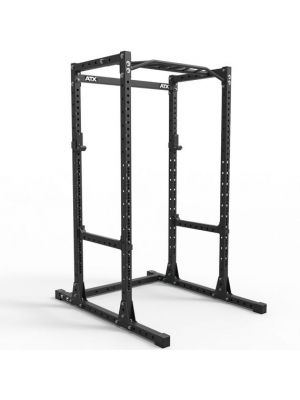
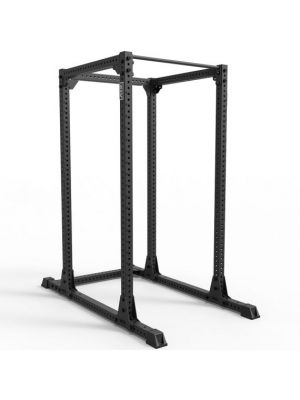
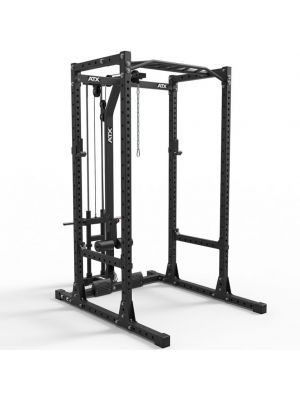
P.S. Here's a quick run through of some of the many power racks we offer through The Gym Revolution: